

What is a rectangle?
Before diving into finding the perimeter of a rectangle, let’s break down what a rectangle is. A rectangle is a four-sided shape (quadrilateral) with four right angles (90° corners). It’s one of the most common shapes you’ll encounter in mathematics, from GCSE geometry to everyday life.
Key Properties of a Rectangle:
- Four sides arranged in two pairs of equal opposite sides
- Four right angles (each corner is 90°)
- Opposite sides are parallel to each other
- Opposite sides are equal in length (length = length, width = width)
- Diagonals are equal in length and bisect each other
A rectangle is actually a special type of parallelogram—it has all the properties of a parallelogram but with the added feature of right angles.
Understanding Rectangle Dimensions
Length (l): The longer side of the rectangle (sometimes called the base) Width (w): The shorter side of the rectangle (sometimes called the height)
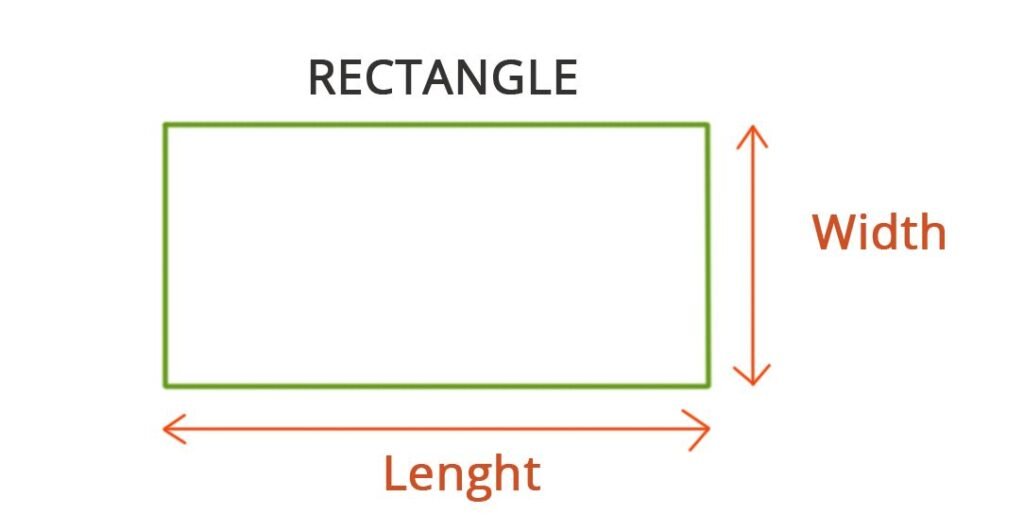
However, in some problems, these terms can be used interchangeably—what matters is that you’re using the correct measurements! Also, if you want to know about calculating triangles, you can read here by clicking on Calculating the area of a triangle. This will help you out.
5 Methods to Find the Perimeter of a Rectangle
Method 1: The Basic Formula (Most Common)
Formula: Perimeter = 2(l + w)
Where l = length and w = width
Example: A rectangle has length 8 cm and width 5 cm.
- Perimeter = 2(8 + 5)
- Perimeter = 2 × 13
- Perimeter = 26 cm
Why it works: A rectangle has two pairs of equal sides, so we add length and width, then multiply by 2.
Method 2: Adding All Four Sides
Formula: Perimeter = l + w + l + w
This is the “long way,” but it helps you understand what “perimeter” means.
Example: Length = 8 cm, Width = 5 cm
- Perimeter = 8 + 5 + 8 + 5
- Perimeter = 26 cm
Why it works: Perimeter is simply the distance around the outside. You add all four sides!
Method 3: Using 2l + 2w
Formula: Perimeter = 2l + 2w
This is another way to write the same concept.
Example: Length = 8 cm, Width = 5 cm
- Perimeter = (2 × 8) + (2 × 5)
- Perimeter = 16 + 10
- Perimeter = 26 cm
Why it works: You multiply each dimension by 2 (because there are two of each side), then add them together.
Method 4: Step-by-Step Visual Method
Imagine drawing around the rectangle:
- Go along the length: 8 cm
- Go down the width: 5 cm
- Go back along the length: 8 cm
- Go up the width: 5 cm
Total distance walked: 8 + 5 + 8 + 5 = 26 cm
This method helps you visualize what ‘perimeter’ actually means—the total distance around the shape.
Method 5: The Substitution Method (For Algebra)
If you need to find the perimeter using variables:
Given: A rectangle where length = 3x and width = 2x
Using P = 2(l + w):
- P = 2(3x + 2x)
- P = 2(5x)
- P = 10x
If x = 2 cm:
- P = 10 × 2 = 20 cm
Why it’s useful: This method helps you work with expressions and equations in algebra.
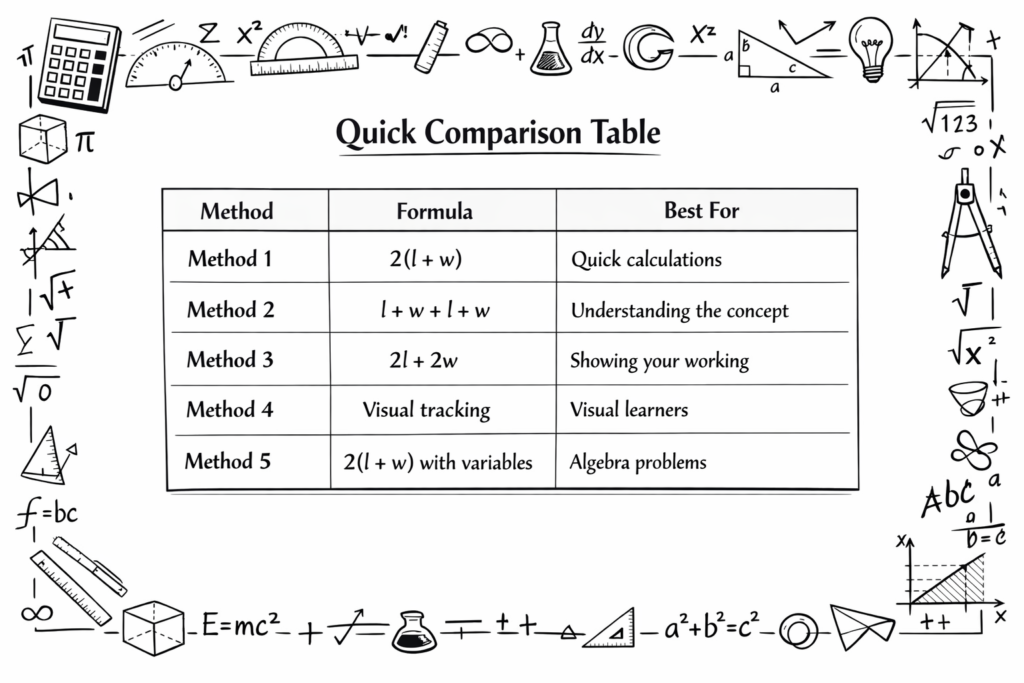
Quick Comparison Table
Top Tips for Exams
✓ Always include units (cm, m, mm, etc.) in your answer
✓ Show your working—examiners want to see your method
✓ Use the formula 2(l + w) for speed and accuracy
✓ Double-check: Does your answer make sense? (Should be larger than either side)
✓ Watch out for mixed units (convert to the same unit first!)
✓ Understand the difference between perimeter and area—they measure different things!
✓ Practice with different rectangle types (standard, square, landscape, portrait)
Example Problem with Full Working
Question: A rectangular garden is 12 meters long and 7 meters wide. A farmer wants to put a fence around it. How much fencing does he need?
Solution:
- Length (l) = 12 m
- Width (w) = 7 m
- Formula: P = 2(l + w)
- P = 2(12 + 7)
- P = 2 × 19
- P = 38 m
Answer: The farmer needs 38 meters of fencing.
Need Expert Help with Geometry?
If you’re finding rectangles and perimeter calculations challenging, or if you’d like to strengthen your understanding of geometry and other math topics, or if you are struggling how to find the perfect online tutor in UK, Math Make Smart is here to help!

Math Make Smart provides expert online maths tutors for UK students, offering personalized one-to-one tutoring tailored to your learning needs. Whether you’re preparing for GCSE exams, Key Stage assessments, or simply want to build confidence in mathematics, our experienced tutors work with you at your own pace.
Why choose Math Make Smart?
- ✓ Qualified, experienced online tutors across the UK
- ✓ Flexible scheduling to fit around your timetable
- ✓ One-to-one personalised learning
- ✓ Proven results and improved confidence
- ✓ Coverage of all topics: geometry, algebra, statistics, and more
- ✓ Support for GCSE, A-Level, and Key Stage maths
Transform your math journey with Math Make Smart—where expert tutoring meets your success!
For more information about our tutoring services, get in touch, book a free demo session and discover how we can help you excel in mathematics.
