
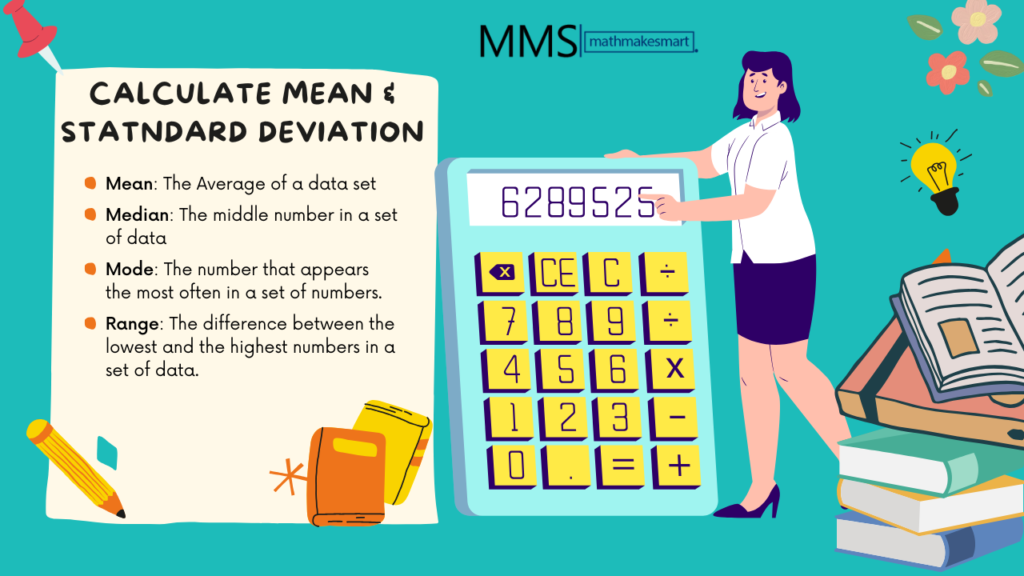
Introduction: Understanding Frequency Tables
Frequency tables are essential in GCSE and A-Level statistics. They help you organize and analyze data efficiently. This guide teaches you to calculate mean and standard deviation from frequency tables—two critical statistical skills you’ll need for exams and coursework.
What Is a Frequency Table?
A frequency table organizes data by grouping values into categories and showing how often each appears.
Example: Instead of listing 50 homework hours separately, group them:
| Hours per Week | Number of Students |
| 0-2 | 8 |
| 2-4 | 15 |
| 4-6 | 20 |
| 6-8 | 7 |
A frequency table has two columns: data values (or class intervals) and frequency (how many times each appears). Understanding this structure is crucial because frequencies affect how you calculate mean and standard deviation.
Understanding Mean in Statistics: The Average Explained
The mean is the average—a single number representing the “centre” of your data.

In a frequency table, you can’t simply average the values. You must weight each value by its frequency. A value appearing 5 times contributes more to the mean than a value appearing once.
Why this matters: The mean gives you a typical value, but extreme numbers can skew it. That’s why statisticians use mean alongside median and mode for a complete picture.
Step-by-Step: How to Calculate Mean from a Frequency Table
Let’s break down the process of calculating mean from a frequency table into clear, manageable steps. This is one of the most essential skills you’ll develop in your statistics studies.
The Formula
The mean from a frequency table is calculated using this formula:
Mean = Σ(x × f) / Σf
Where:
- x = each data value (or class midpoint for grouped data)
- f = the frequency of that value
- Σ = “sum of” (add them all up)
Step 1: Identify Your Data
Start by carefully examining your frequency table. Identify all the data values in one column and their corresponding frequencies in another column. Make sure you understand whether you’re working with individual values or class intervals.
Step 2: Calculate x × f for Each Row
Create a new column where you multiply each data value by its frequency. This gives you the total contribution of each value to the overall sum. For example, if the value 5 appears 3 times, you’d calculate 5 × 3 = 15.
Step 3: Sum All the x × f Values
Add up all the values in your x × f column. This gives you the numerator of your formula: Σ(x × f).
Step 4: Sum All the Frequencies
Add up all the frequencies in your frequency column. This gives you the denominator: Σf. This number tells you the total number of data points in your dataset.
Step 5: Divide to Find the Mean
Divide your total from Step 3 by your total from Step 4. The result is your mean. Round to an appropriate number of decimal places based on your data and the requirements of your assignment.
Example:
| Books Read (x) | Frequency (f) | x × f |
| 0 | 4 | 0 |
| 1 | 8 | 8 |
| 2 | 10 | 20 |
| 3 | 5 | 15 |
| 4 | 2 | 8 |
| Total | 29 | 51 |
Mean = 51 ÷ 29 = 1.76 books
Why This Method Works
You might wonder why we need to do all this multiplication rather than just averaging the values in the table directly. The answer is that the frequency tells us how important each value is. A value that appears 20 times should influence our mean much more than a value that appears only twice. By multiplying each value by its frequency before averaging, we ensure that our mean accurately reflects the true center of the entire dataset.
What Is Standard Deviation? Understanding Spread
Standard deviation measures how spread out data is from the mean. A small standard deviation means data clusters near the mean. A large standard deviation means data is scattered.
Example: Two classes both average 75% on a test:
- Class A: Most scores between 70-80% (low standard deviation)
- Class B: Scores range from 40-95% (High standard deviation)

Standard deviation shows Class B has much more variation.
Calculating Standard Deviation from Frequency Tables: The Complete Process
Calculating standard deviation from a frequency table involves several steps, but don’t worry—once you understand the logic, it becomes straightforward. We’ll work through both the conceptual understanding and the practical calculations.
The Formula
There are two formulas you might encounter, depending on whether you’re working with a population or a sample:
For a population: σ = √[Σ(x – μ)² × f / Σf]
For a sample: s = √[Σ(x – x̄)² × f / (Σf – 1)]
Where:
- x = each data value
- μ or x̄ = the mean
- f = the frequency
- σ or s = standard deviation
Most of the time in UK curriculum work, you’ll use the sample formula unless specifically told otherwise.
Step 1: Calculate the Mean
Before you can calculate standard deviation, you need the mean. Use the method we described earlier: Σ(x × f) / Σf. Let’s say you calculate your mean as 25.
Step 2: Calculate (x – mean) for Each Value
For each data value, subtract the mean from it. If your value is 20 and your mean is 25, then (x – mean) = 20 – 25 = -5. Don’t worry about negative numbers—we’re going to square them in the next step anyway.
Step 3: Square Each Difference
Take each value from Step 2 and square it: (x – mean)². Using our example: (-5)² = 25. Squaring removes the negative signs and emphasizes larger differences from the mean.
Step 4: Multiply by Frequency
Multiply each squared difference by its frequency: (x – mean)² × f. This accounts for how many times each value appears in the dataset.
Step 5: Sum All the Results
Add up all the values from Step 4: Σ[(x – mean)² × f]. This is the numerator of your formula.
Step 6: Divide by Total Frequency (or frequency minus 1)
Divide your sum from Step 5 by either Σf (for population) or (Σf – 1) for a sample. Most school work uses the sample formula, so you’ll typically divide by (Σf – 1).
Step 7: Take the Square Root
Finally, take the square root of your answer from Step 6. This gives you your standard deviation. Use a calculator for this final step—it’s much easier and more accurate than trying to calculate by hand.
Understanding Each Step
The beauty of this process is that each step has a clear meaning. We’re essentially measuring how far each data point deviates from the mean, weighting these deviations by their frequency, and then taking a kind of “average” of these deviations. The square root at the end brings the result back to the original units of our data, making it more interpretable.
Worked Example: Calculating Mean from a Frequency Table
Let’s work through a complete example so you can see exactly how this all comes together in practice.
The Problem
A UK teacher asked 30 students how many books they’d read in the past month. Here’s the frequency table:
| Number of Books (x) | Frequency (f) | x × f |
| 0 | 4 | 0 |
| 1 | 8 | 8 |
| 2 | 10 | 20 |
| 3 | 5 | 15 |
| 4 | 2 | 8 |
| 5 | 1 | 5 |
| Total | 30 | 56 |
Calculation
Mean = Σ(x × f) / Σf = 56 / 30 = 1.87 books (to 2 decimal places)
Interpretation
On average, these students read approximately 1.87 books in the past month. Even though no student read exactly 1.87 books, this number represents the central tendency of the group. If you were the teacher trying to understand the reading habits of your class, you’d know that the typical student read just under 2 books during this period.
Notice how the frequency column weighted our calculation. The value “2 books” appeared 10 times out of 30 total responses, so it had a significant influence on pulling our mean closer to 2. The values 4 and 5 books appeared rarely, so they barely influenced the final mean.
Worked Example: Calculating Standard Deviation from a Frequency Table
Now let’s calculate the standard deviation for the same book-reading dataset. This will show you the full process and how standard deviation adds to your understanding of the data.
Continuing from Our Previous Example
We already know the mean is 1.87 books. Now we’ll calculate how spread out the data actually is.
| x | f | (x – 1.87) | (x – 1.87)² | (x – 1.87)² × f |
| 0 | 4 | -1.87 | 3.50 | 14.00 |
| 1 | 8 | -0.87 | 0.76 | 6.08 |
| 2 | 10 | 0.13 | 0.02 | 0.20 |
| 3 | 5 | 1.13 | 1.28 | 6.40 |
| 4 | 2 | 2.13 | 4.54 | 9.08 |
| 5 | 1 | 3.13 | 9.80 | 9.80 |
| Total | 30 | 45.56 |
Calculation
Standard deviation = √[45.56 / (30 – 1)] = √[45.56 / 29] = √1.57 = 1.25 books
Interpretation
The standard deviation is 1.25 books. This tells us that, on average, students’ reading habits deviated from the mean of 1.87 books by about 1.25 books. In practical terms, this suggests there’s quite a bit of variation in how much the students read. Some students read very little, while others read quite a lot, and this variation is captured by our standard deviation of 1.25.
If we’d calculated the standard deviation for a different class and found it was only 0.4 books, we’d know that class had much more consistent reading habits—most students read a similar amount. Conversely, if another class had a standard deviation of 2.5 books, we’d know that class had much more diverse reading habits.
Common Mistakes to Avoid When Calculating Mean and Standard Deviation
As you practice these calculations, watch out for these common errors that trip up many students:
Mistake 1: Forgetting to Multiply by Frequency
The biggest mistake students make is calculating the mean of just the x values without considering their frequencies. Always remember: each value must be multiplied by how many times it appears. If you just average the x column, you’ll get a completely incorrect answer.
Mistake 2: Using (Σf) Instead of (Σf – 1) for Standard Deviation
In UK curriculum statistics, you’re typically working with a sample of data, not an entire population. This means you should divide by (Σf – 1) rather than Σf when calculating standard deviation. Using Σf will give you a slightly smaller result and is technically incorrect for sample data.
Mistake 3: Forgetting to Take the Square Root
After dividing by the frequency count, many students forget the final crucial step: taking the square root. Without this step, you haven’t actually calculated the standard deviation—you’ve calculated the variance, which is a different measure entirely.
Mistake 4: Rounding Too Early
It’s tempting to round intermediate answers to make calculations easier, but this introduces rounding errors that compound throughout your calculation. Keep at least 2-3 extra decimal places during intermediate steps, and only round your final answer.
Mistake 5: Misidentifying Class Midpoints
When working with grouped frequency tables (like “10-20,” “20-30”), some students use the lower class limit or upper class limit instead of the true midpoint. The midpoint of 10-20 is 15, not 10 or 20. Always use the class midpoint for calculations.
Mistake 6: Misunderstanding Negative Values
When you calculate (x – mean), you’ll often get negative numbers. This is perfectly fine. The negative signs disappear when you square the values in the next step. Don’t try to “fix” negative values by taking absolute values instead of squaring—that’s mathematically incorrect.
Using Technology: Calculators and Spreadsheets
While it’s important to understand the calculations by hand, technology can help you verify your work and save time. Let’s explore some tools that can help.

Graphing Calculators
Most graphing calculators (like the Casio FX-991 or equivalent) have built-in statistics functions. You can input your frequency data and the calculator will automatically compute mean and standard deviation. Check your calculator’s instruction manual to learn the specific steps for your model. This is especially useful for checking your hand calculations.
Spreadsheet Software
Microsoft Excel, Google Sheets, and similar spreadsheet software are excellent for working with frequency tables. You can create columns for x, f, and x×f, letting the spreadsheet do the multiplication. For standard deviation, you can use the STDEV.S() function for sample standard deviation. These tools make it easy to experiment with different datasets and see how changes affect your results.
Online Calculators
Many websites offer free online calculators for mean and standard deviation from frequency tables. While these are great for checking your answers, make sure you understand the underlying mathematics rather than relying entirely on technology. Your exams will require you to show your working, and you’ll need to understand what you’re calculating.
Important Note
Whether using technology or not, always show your working in exams. Examiners want to see that you understand the process, not just that you can get the right answer. Technology is a verification tool, not a substitute for mathematical understanding.
Practice Problems: Test Your Understanding
Now it’s time to practice. Here are some problems to help you solidify your understanding of calculating mean and standard deviation from frequency tables.
Practice Problem 1: Simple Data
A coffee shop recorded how many cups of coffee they sold each day over a month. Here’s the frequency table:
| Cups Sold | Frequency |
| 40 | 2 |
| 45 | 5 |
| 50 | 8 |
| 55 | 10 |
| 60 | 5 |
Calculate (a) the mean number of cups sold and (b) the standard deviation.
Practice Problem 2: Grouped Data
A school recorded the heights of 40 students. Here’s the grouped frequency table:
| Height (cm) | Frequency |
| 150-160 | 5 |
| 160-170 | 12 |
| 170-180 | 15 |
| 180-190 | 8 |
Calculate (a) the mean height and (b) the standard deviation. (Remember to use class midpoints: 155, 165, 175, 185)
Practice Problem 3: Challenge Problem
A shop recorded the number of items purchased by customers on a busy Saturday:
| Items Purchased | Frequency |
| 1 | 15 |
| 2 | 22 |
| 3 | 18 |
| 4 | 12 |
| 5 | 8 |
| 6 | 5 |
Calculate (a) the mean and (b) the standard deviation. Then write a sentence explaining what the standard deviation tells us about customer shopping patterns.
Work through these problems using the methods we’ve discussed. You’ll find the answers strengthen your understanding far more than simply reading about the methods. If you are looking for the best online math tutor in the UK, then Math Make Smart is the best choice for many people specially in English, Math and Science subjects. Math Make Smart has a large number of reviews on Trustpilot because of their hard work and efforts to resolve the issues that many children and their parents face. You can also trust Math Make Smart.
Ready to Excel in Statistics?
If you’re finding statistics challenging, you’re not alone. Many students struggle with these concepts initially. That’s where professional support can make a real difference. Math Make Smart specializes in helping UK students master mathematics, english, and science through personalized online tutoring. Whether you’re preparing for GCSEs, A-Levels, or heading to university, our experienced tutors can guide you through these concepts with clear explanations and plenty of practice problems.
We don’t just help you pass exams—we help you truly understand the material, which means you’ll retain it and apply it confidently in future studies. Our online tutoring service works with students across the UK, USA, Ireland, Canada, New Zealand, and Australia, and we cover mathematics, English, science, biology, computer science, and physics.
Whether you are wondering how to choose the best online tutor in UK or you need help with frequency tables, statistical analysis, calculus, or any other subject, Math Make Smart tutors are here to support your learning journey. Every student is unique, and every student deserves personalized attention that meets them where they are. Visit Math Make Smart to learn more about how we can help you achieve your academic goals.
Frequently Asked Questions
Q: What’s the difference between mean and median? Mean is the average. The median is the middle value. The mean can be skewed by extreme values; the median isn’t.
Q: Why divide by (n-1) instead of (n)? When using sample data (nearly always in school), dividing by (n-1) gives a more accurate estimate of population standard deviation.
Q: Can standard deviation be negative? No. Standard deviation is always positive or zero (when all values are identical).
Q: How do I know if standard deviation is “large” or “small”? Compare it to the mean. If standard deviation is much smaller than the mean, data is consistent. If similar to or larger than the mean, data is spread out.
Q: What if my frequency table has decimals? The process is identical. Treat decimals like whole numbers throughout calculations.
Q: Are mean and standard deviation always best? No. For skewed data or outliers, use mean with median and mode for better understanding.
