
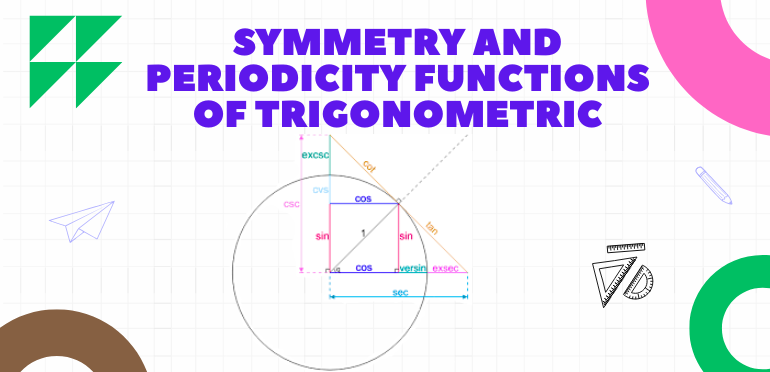
Introducing Functions Of Trigonometric
If you are studying trigonometry, one of the most essential concepts you need to understand is the symmetry and periodicity functions of trigonometric equations. These concepts will enable your students to understand the symmetry and periodicity of trigonometric graphs. Without these concepts, solving trig equations, analyzing graphs, and learning identities will be much more difficult. In this tutorial, I will explain these concepts in simple terms, with examples.
What Are Symmetry and Periodicity in Trigonometric Functions?
In the discussion of symmetry and periodicity in trigonometric functions, two essential properties are identified:
-
Symmetry:
A function is symmetric if it remains unchanged when reflected over a given axis or the origin. In the context of trigonometry:
- Some functions are even → symmetric about the y-axis.
- Some functions are odd → symmetric about the origin.
-
Periodicity:
A function is periodic if it has a repetition pattern after a certain period of time, with the duration of the period being defined as the period.
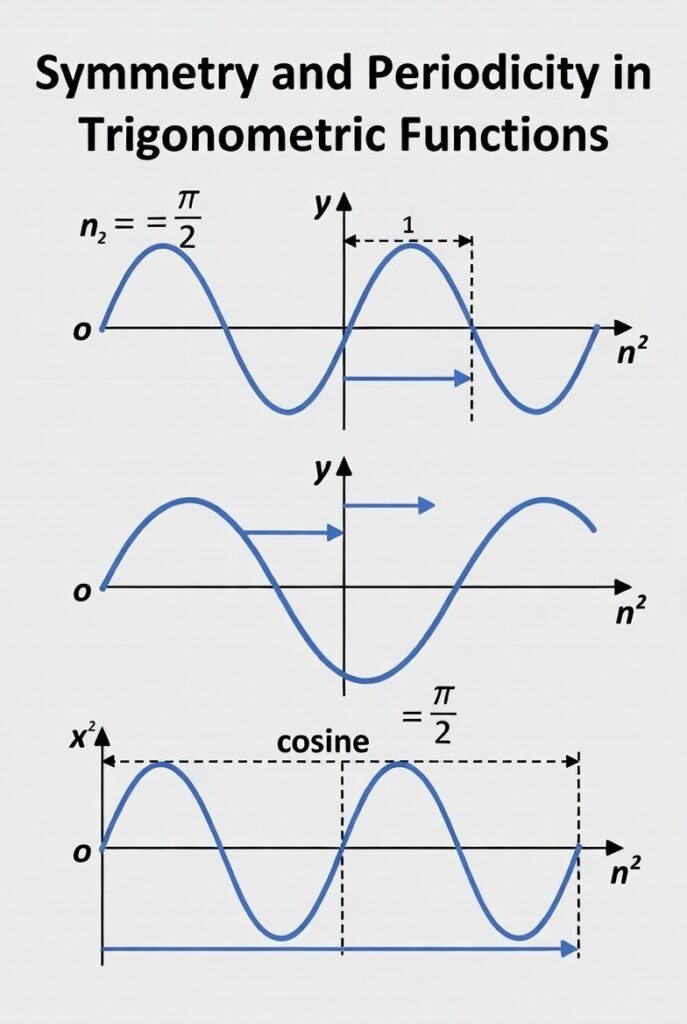
Understanding both concepts help graphing, making predictions, and identification easier.
The Significance of Symmetry and Periodicity
Based on experience as an online math tutor, introductory trigonometry can seem confusing at first. But when students see how functions display repetition and reflection, it becomes less intimidating:
- The new values do not have to be calculated every time; there are many values that repeat.
- Graphs show predictability.
- There are many trigonometric identities that can be derived from symmetry.
- Equation and inequality problem-solving skills are accelerated.
Symmetry in Trigonometric Functions
Trigonometric functions fall into two symmetry types:
- Even Functions (Symmetry about the y-axis)
A function is said to be even if:
f(−x) = f(x)
That is, the graph is symmetric with respect to the y-axis; the left side is the mirror image of the right side.
Even Trigonometric Functions are Cos x and Sec x
Examples of Even Symmetry:
- Cos (−45°) = Cos (45°)=22
- Sec(−x°) = Sec(x°)
- Odd Functions (Symmetry about the x-axis)
A function is said to be odd if:
f(−x) = − f(x)
This means that the graph of an odd function is unchanged under a 180° rotation about the origin.
Odd Trigonometric Functions are:
- Sin x
- Tan x
- Csc x
- Cot x
Examples of Odd Symmetry:
- Sin(−x°) =− Sin(x°)
- Tan(−θ°) = −Tan (θ°)
Note: These symmetry rules are essential when studying the symmetry and periodicity functions of trigonometric graphs.
Periodicity of Trigonometric Functions
A function is periodic if:
f(x+T) = f(x)
Here, T is the period.
| Standard Periods of Trigonometric Functions | |
| Sin x | 2π |
| Cos x | 2π |
| Sex x | 2π |
| Csc x | 2π |
| Tan x | π |
| Cot x | π |
Why do they repeat?
The reason for this repetition in the trigonometric functions is the circular nature of the unit circle. The angles in a circle repeat after every 360 degrees or 2π radians.
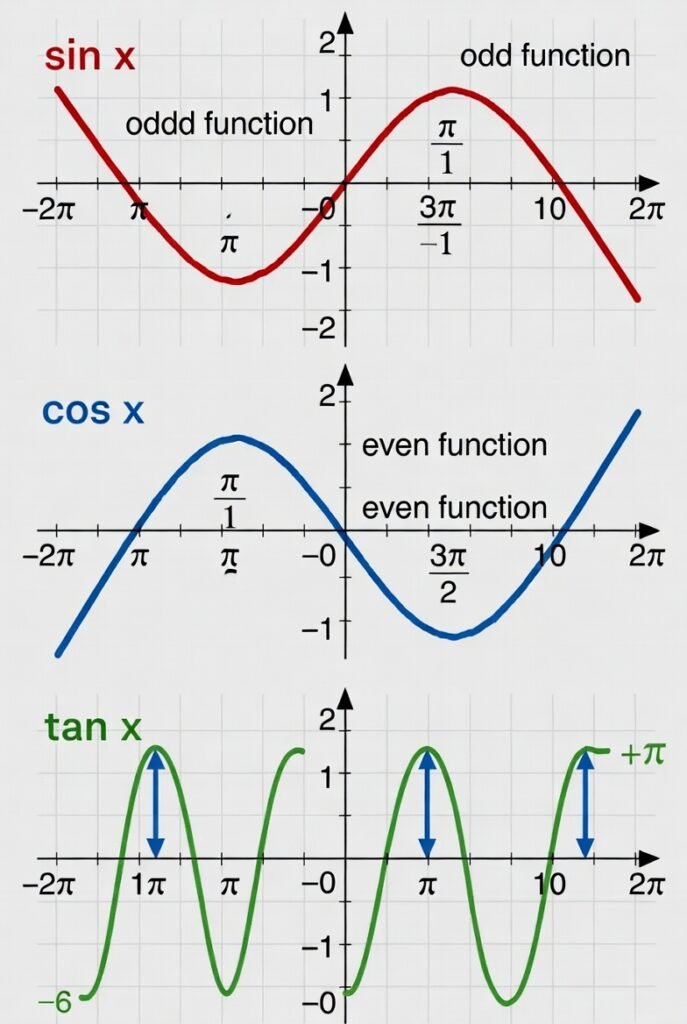
Examples of Periodicity:
Example 1: Periodicity of Sine
Sin (x+2π) = Sin x
- Sin (30°+360°) = Sin (390°)
- Sin (390°) = Sin (30°)
Example 1: Periodicity of Tangent
Tan (x+ π) = Tan x
- Tan (45°+180°) = Tan (225°)
- Both equals to 1
Solved Examples
The following are solved examples based on real tutoring work.
Example 1: Determine Symmetry of f (x) =3 Cos x.
Step 1: Replace x with – x.
f(−x) = 3 Cos (−x)
Step 2: Use Identity
Cos (−x) = Cos x
So,
f(−x) = 3 Cos x = f(x)
So, This is an Even function (Symmetric about the y-axis)
Example 2: Check if g(x)=2 Sin x is even, odd, or neither.
g(−x) = 2 Sin (−x)
we know that
Sin (−x) = − Sin (x)
So,
g (−x) = −2 Sin x = −g (x)
So, This is an Odd function (Symmetric about the Origin)
Example 3: Find the period of h(x)= Tan (2x)
Standard period of Tan x = π
When x is multiplied by 2, Period = 2
So, The graph repeates every 2
Example 4: Use periodicity to simplify Sin (840°)
Since Sine repeats every 360°
840° − 360° = 480°
480° − 360° = 120°
So,
Sin(840°) = Sin(120°)
Example 5: Use symmetry to find Tan(−210°)
Since Tan is odd.
Tan (−x) = − Tan x
Thus,
Tan (−210°) = − Tan (210)
Tan (210°) = 1
So,
Tan (−210°) = −1
Tips for Students Learning Symmetry and Periodicity:
- Start by memorizing the types of symmetry.
- Draw some rough graphs; pictures are much more valuable than equations.
- Apply periodicity to simplify large angles.
- Practice converting negative angles to positive angles.
- Before solving, it is necessary to check if the trig function is even or odd.
These are habits that make learning the symmetry and periodicity functions of trigonometric equations enjoyable.
In conclusion,
Mastering symmetry and periodicity functions of trigonometric functions is foundational to trigonometry, enabling learners to recognize even functions like cosine and secant (symmetric about the y-axis) and odd functions like sine, tangent, cosecant, and cotangent (symmetric about the origin), while understanding periodic repetitions—such as 2π for sine, cosine, secant, and cosecant, and π for tangent and cotangent—rooted in the unit circle’s cyclical nature.
Through examples of simplifying angles and verifying symmetries, along with practical tips like graphing and memorizing properties, these concepts demystify equations, graphs, and identities, making problem-solving more efficient and intuitive for students.
For students and parents in the UK, USA, Canada, Ireland, New Zealand, and Australia seeking to simplify math challenges like trigonometry, online math tutors offer unparalleled advantages, including flexible scheduling around school hours or work commitments, access to expert tutors from anywhere without geographical barriers, and personalized sessions tailored to individual learning paces.
Platforms providing online tutoring in UK make complex topics approachable through interactive tools, real-time feedback, and resources like video explanations, helping build confidence and strong foundations in maths while accommodating diverse time zones and curricula such as GCSE, A-Levels, SATs, or IB programmes.
