
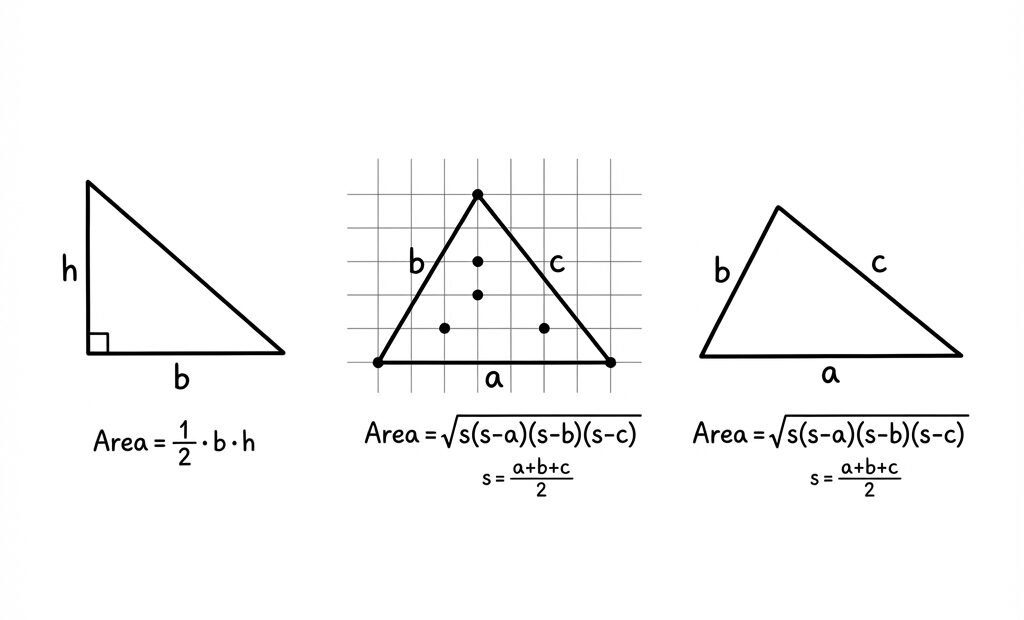
Introduction
Finding the area of a triangle is one of the fundamental skills in geometry that students learn early in their educational journey. Whether you’re preparing for GCSE maths exams or helping your child with homework, understanding how to calculate a triangle’s area using its base and height is essential. At Math Make Smart, our experienced online tutors in UK help thousands of students master these core mathematical concepts with confidence.
The beauty of triangle area calculations lies in their simplicity when you know the base and height. In this guide, we’ll walk you through three different approaches to solve triangle area problems, ensuring you grasp the concept thoroughly.
What Are Base and Height in a Triangle?
Before diving into calculations, let’s clarify two critical elements:
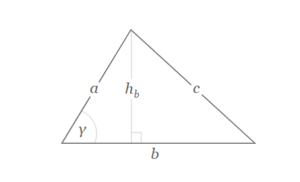
The base is any side of the triangle you choose as your reference line. The height (or altitude) is the perpendicular distance from this base to the opposite vertex. This perpendicular measurement is crucial for accurate calculations.
Understanding these definitions helps when working with different triangle types—whether you’re dealing with a right triangle, isosceles triangle, or scalene triangle. Our online tutors in UK always emphasize this foundational knowledge before moving to practical problems.
Method 1: The Standard Formula (Most Common Approach)
This is the quickest and most straightforward way to calculate triangle area.
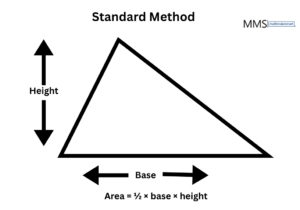
Formula: Area = ½ × base × height
Step-by-step guide:
- Identify your base – Choose any side of the triangle
- Measure the height – Find the perpendicular distance from that base to the opposite point
- Multiply base × height – Use your measurements
- Divide by 2 – Split the result in half to get your area
- Add units – Always include the squared unit (cm², m², etc.)
Example: A triangle has a base of 8 cm and height of 5 cm.
- Base × Height = 8 × 5 = 40
- Divide by 2 = 40 ÷ 2 = 20 cm²
This method works for any triangle, regardless of shape. UK mathematics educators recommend starting with this approach when teaching triangle geometry to students.
Method 2: Using Grid Counting (Visual Approach)
This method suits younger learners and helps develop spatial reasoning skills.
Step-by-step guide:
- Draw your triangle on grid paper – Each square represents one unit
- Count complete squares inside – Mark each full square covered by the triangle
- Count partial squares – Identify squares that are partially inside the triangle
- Combine your counts – Add complete squares plus half of the partial squares
- Calculate total area – This gives you your triangle’s area in square units
Example: If you count 16 complete squares and 8 partial squares:
- Complete squares = 16
- Partial squares ÷ 2 = 8 ÷ 2 = 4
- Total area = 16 + 4 = 20 square units
Online tutors frequently use this visual method to help students understand why the formula works, making maths education more engaging and intuitive.
Method 3: Heron’s Formula (When You Know All Three Sides)
When you have the measurements of all three sides but lack the height, Heron’s formula provides an elegant solution.
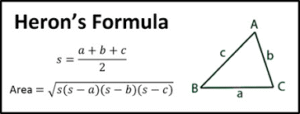
Formula: Area = √[s(s-a)(s-b)(s-c)]
Where ‘s’ is the semi-perimeter: s = (a + b + c) ÷ 2
Step-by-step guide:
- Add all three sides – a + b + c = perimeter
- Divide by 2 – This gives your semi-perimeter (s)
- Calculate each difference – Work out (s-a), (s-b), and (s-c)
- Multiply all four values – s × (s-a) × (s-b) × (s-c)
- Take the square root – Find √ of your result
- Write your answer – Include the appropriate unit squared
Example: Triangle with sides 5 cm, 6 cm, and 7 cm:
- Perimeter = 5 + 6 + 7 = 18
- Semi-perimeter (s) = 18 ÷ 2 = 9
- Calculate: 9 × (9-5) × (9-6) × (9-7) = 9 × 4 × 3 × 2 = 216
- Square root of 216 = 14.7 cm²
This advanced method is particularly useful for geometry students and those working with scalene triangles where height measurement isn’t readily available.
Quick Comparison Table
| Method | Best For | Requirements | Difficulty |
| Standard Formula | All triangles | Base and height | Easy |
| Grid Counting | Visual learners | Graph paper, clear shape | Simple |
| Heron’s Formula | All three sides known | Three measurements | Moderate |
Common Mistakes to Avoid
When calculating triangle area, students often make these errors. Awareness helps prevent them:
Forgetting to divide by 2 – The most frequent mistake. Always remember that a triangle is half of a rectangle.
Confusing height with slant – The height must be perpendicular to the base, not the slanted side.
Wrong units – Ensure your final answer includes squared units (never just cm or m).
Mixing up sides and height – In Heron’s formula, all three sides are needed, not just two.
Why Choose Online Tutors in the UK for Maths Help?
Getting personalized support from qualified online tutors can transform your understanding of geometric concepts. At Math Make Smart, our experienced UK-based tutors provide:
- One-to-one guidance tailored to your learning pace
- Interactive lessons using visual demonstrations
- Exam preparation specifically for UK curricula
- Flexible scheduling that fits around your routine
- Progress tracking to monitor improvement
Whether you’re struggling with basic triangle calculations or advanced geometry problems, having access to expert maths tutoring makes a significant difference in your academic performance.
Practice Questions to Master the Concept
Ready to test your knowledge? Try these problems using the methods we’ve covered:
- A triangle has a base of 12 cm and a height of 8 cm. Calculate its area.
- Using grid counting, determine the area of a triangle covering 24 complete squares and 10 partial squares.
- A triangle has sides measuring 8 cm, 10 cm, and 12 cm. Use Heron’s formula to find the area.
These exercises help reinforce learning and build confidence with triangle area calculations.
Conclusion
Calculating the area of a triangle with base and height doesn’t have to be complex. Whether you prefer the straightforward standard formula, the visual grid method, or the comprehensive Heron’s formula approach, you now have multiple tools in your mathematical toolkit.
Consistent practice with these methods ensures mastery. If you find yourself struggling, find the best online tutor in the UK for triangle geometry or other maths topics, and remember that support is available. Online tutors in the UK, including those at Math Make Smart, specialize in breaking down challenging concepts into manageable, easy-to-understand steps.
Ready to boost your math confidence? Connect with our professional online tutors today, book a free demo session and transform your approach to geometry and beyond.
