
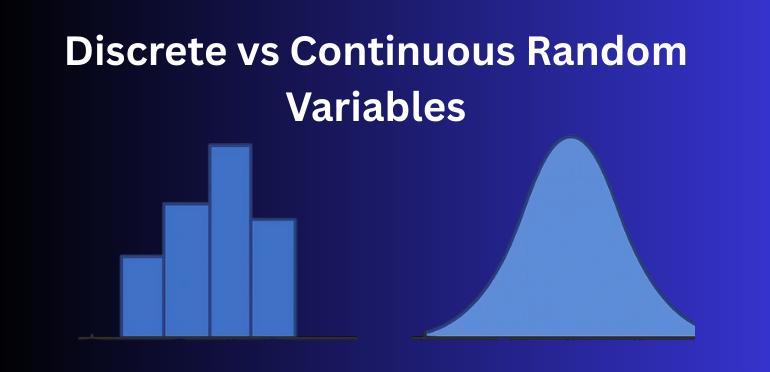
Introduction
This short exam guide helps you quickly understand and identify discrete vs continuous random variables. These are key ideas in probability and statistics that appear in school exams, tests, and entrance papers. With simple rules, examples, and tips, you’ll spot the difference easily and score better on questions about random variables. If you need help in any subject and are looking for private tutoring for your kids, you can visit Math Make Smart and book a free demo session.
Random Variable
A variable whose value depends on chance (from an experiment).
Discrete
- Takes countable values (usually whole numbers: 0, 1, 2…)
- No values possible between them
- From counting
Continuous
- Takes any value in an interval (includes decimals)
- Infinite possibilities between any two values
- From measuring
Exam Quick Rule
- Counting people/items/events → discrete
- Measuring height/time/weight/temperature → continuous
- Ask: “Can it be 2.7?” → Yes = continuous, No = discrete
Exam-Style Worked Examples
Example 1 (Typical MCQ / Short Answer)
In a survey of 50 students, let X = number who own a smartphone.
Possible values: 0, 1, 2, …, 50
Is X discrete or continuous?
Answer: Discrete (only whole numbers, countable).
Example 2 (Common Exam Question)
Let Y = time (in seconds) a student takes to solve a math problem.
Possible values: any number like 45.2 s, 45.23 s, etc.
Is Y discrete or continuous?
Answer: Continuous (any value in a range is possible).
Example 3 (Tricky Exam Type)
Let Z = number of goals scored by a football team in a match.
Is Z discrete or continuous?
Answer: Discrete (0, 1, 2, 3… goals — no half goals).
Example 4 (Exam Favorite)
Let W = weight of apples in a basket (in kg).
Possible values: 0.15 kg, 0.152 kg, etc.
Is W discrete or continuous?
Answer: Continuous (measured, decimals allowed).
Example 5 (Multiple Choice Style)
Which is continuous?
- A) Number of pages in your textbook read today
- B) Exact length of your desk in cm
- C) Number of cars in parking lot
- D) Number of questions attempted in exam
Answer: B (length can be 120.45 cm, etc.).
Visuals for Exams (graphs often appear in questions)
For Discrete – use bar graph (gaps between bars)
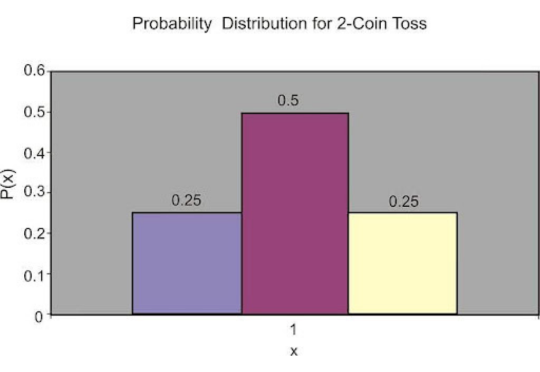
(Shows bar graph for coin toss heads – typical discrete probability)
For Continuous – use smooth curve (no gaps)
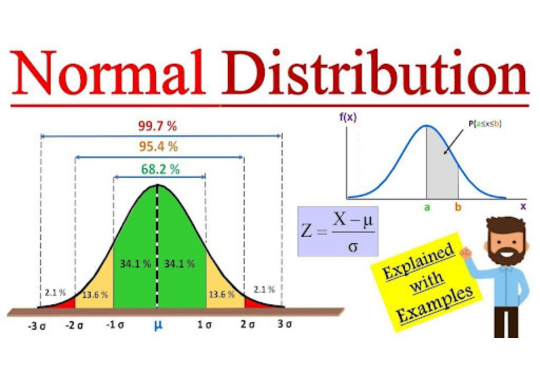
(Bell curve – normal distribution, common for continuous)
Side-by-Side Comparison Table (great for quick revision)
| Questions to Ask | Discrete Example | Continuous Example |
| Counting or measuring? | Number of correct answers | Time to finish paper |
| Whole numbers only? | Yes (0,1,2…) | No (1.5 min, 1.52 min…) |
| Graph in exam | Bars with gaps | Smooth line/curve |
| Probability calculation | P(X = 3) directly | Area under curve |
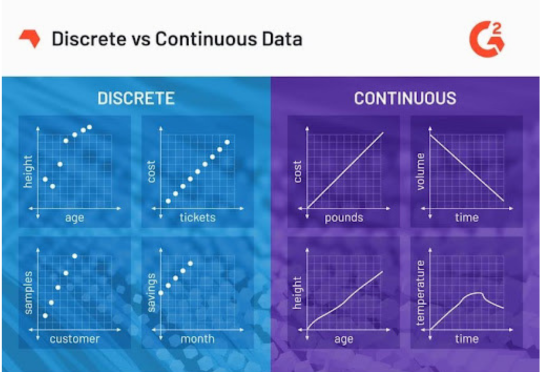
(Visual comparison – discrete points vs continuous line)
Fast Exam Tips
- Look for words: number of, count, how many → discrete
- Look for words: time, length, weight, temperature → continuous
- “Exactly 170 cm” possible? → continuous (heights vary continuously)
- “Exactly 5 students” only? → discrete
- Graphs: bars/gaps = discrete; curve/area = continuous
Practice Questions (Exam Level)
- Number of typos in a 10-page assignment → ?
- Height of students in your class → ?
- Number of text messages received in a day → ?
- Amount of petrol left in a car tank → ?
(Answers: 1. discrete, 2. continuous, 3. discrete, 4. continuous)
Conclusion
In summary, discrete random variables come from counting (whole numbers only), while continuous ones come from measuring (any value, including decimals). Mastering this helps you handle probability questions fast and correctly in exams. Online math education is growing fast in the UK and other countries. With flexible online math tutors, students can learn these topics at their own pace, get personal help, clear doubts quickly, and improve grades from home. This makes strong math skills easier to build, no matter where you live in Europe. Try free online demo lessons today for better results and more confidence!
