

Introduction
Welcome, aspiring mathematicians and curious minds! Are you finding yourself staring at trigonometry problems, wondering where to even begin? You’re not alone. Many students find trigonometry a bit intimidating at first, but with the right approach and a clear, step-by-step guide, you can master it. This blog post is designed to show you how to solve trigonometry problems step by step for beginners, breaking down complex concepts into manageable chunks. We’ll cover the essentials, from understanding the basics of angles and sides to applying key trigonometric ratios, making your journey into trigonometry both understandable and enjoyable.
1. What is Trigonometry, Anyway?
Before we dive into how to solve trigonometry problems step by step for beginners, let’s understand what trigonometry is. At its core, trigonometry is a branch of mathematics that studies the relationships between the sides and angles of triangles. Specifically, it often focuses on right-angled triangles—those with one angle measuring exactly 90°.
These relationships are fundamental in fields like engineering, physics, architecture, navigation, and even video game development! Understanding these basics is the first step towards confidently solving problems. It’s about figuring out unknown lengths and angles when you have some pieces of the puzzle already
2. Essential Terminology and Concepts
To get started, you’ll need to familiarize yourself with some key terms that form the bedrock of trigonometry:
Right-Angled Triangle:
A triangle with one angle measuring exactly 90 °. This specific type of triangle is the foundation for much of basic trigonometry, as the trigonometric ratios are defined within its structure.
Hypotenuse:
This is always the longest side of a right-angled triangle. Crucially, it is always located directly opposite the right angle.
Opposite Side:
The side that is directly across from a given acute angle (an angle less than 90 degrees) that you are focusing on in the triangle.
Adjacent Side:
The side that is next to, or “adjacent to”, a given acute angle. It’s important to remember that this side is not the hypotenuse; it’s the other side that forms the angle with the hypotenuse.
Angles:
Measured in degrees or radians. For beginners, we typically work with degrees, especially acute angles.
SOH CAH TOA:
This is a mnemonic device—a memory aid—that is incredibly helpful for remembering the three primary trigonometric ratios. We’ll explore it in detail next.
3. The Power of SOH CAH TOA: Understanding Trigonometric Ratios
This mnemonic is your best friend when learning how to solve trigonometry problems step by step for beginners. It provides a simple way to remember the definitions of the three fundamental trigonometric ratios: Sine, Cosine, and Tangent.
SOH: Sine (θ) = Opposite / Hypotenuse
The sine of an angle is the ratio of the length of the side opposite the angle to the length of the hypotenuse.
CAH: Cosine (θ)= Adjacent / Hypotenuse
The cosine of an angle is the ratio of the length of the side adjacent to the angle to the length of the hypotenuse.
TOA: Tangent (θ)= Opposite / Adjacent
The tangent of an angle is the ratio of the length of the side opposite the angle to the length of the side adjacent to the angle. These ratios are constant for a given angle, no matter how big or small the right triangle is. This is a powerful concept because it means that if you know an angle, you know the ratio of its sides, and vice versa. Learning these by heart and understanding how to apply them is crucial for solving problems.
4. How to Solve Trigonometry Problems Step by Step for Beginners: A Practical Guide
This section will walk you through a general process for tackling trigonometry problems. Follow these steps methodically, and you’ll find that even complex problems become manageable.
Step 1:
Understand the Problem and Draw a Diagram Read Carefully: Start by reading the problem multiple times to fully grasp what information is provided (known angles, known side lengths) and what you are being asked to find (unknown angle, unknown side).
Visualize: Always draw a clear, labelled diagram of the right-angled triangle. This is perhaps the most important first step. Sketching helps you visualize the relationships.
Label Knowns and Unknowns: On your diagram, clearly label all the angles and side lengths you know. Use a variable (like $x$ or $y$) for the unknown quantity you need to calculate.
Step 2:
Identify the Reference Angle Choose Your Focus: Determine which acute angle in the triangle you will be working with. This “reference angle” is the angle that dictates which sides are considered “opposite” and “adjacent.” If the problem gives you an angle, that’s usually your reference. If you’re trying to find an angle, that will be your reference angle too.
Step 3:
Label the Sides Relative to Your Angle: Based on your chosen reference angle from Step 4.2, correctly label the three sides of the triangle: Hypotenuse: Always opposite the right angle. Opposite Side: Directly across from your reference angle. Adjacent Side: Next to your reference angle (and not the hypotenuse). This is a critical step; mislabelling these will lead to incorrect answers.
Step 4:
Choose the Correct Trigonometric Ratio Match What You Have to What You Need: Look at the information you have (the known side length(s) and/or angle) and what you need to find (the unknown side or angle). Select the Best Fit: Pick the trigonometric ratio from SOH CAH TOA that involves both the pieces of information you have and the piece of information you need to find. If you know/need Opposite and Hypotenuse, use SOH. If you know/need Adjacent and Hypotenuse, use CAH. If you know/need Opposite and Adjacent, use TOA.
Step 5:
Set Up the Equation and Solve Formulate the Equation: Write down the trigonometric equation using the chosen ratio, the angle, and the side lengths (both known and unknown). For example, if you chose Sine Sin(θ) = Opposite/Hypotenuse
Substitute Values: Plug in all the known numerical values into your equation. Solve Algebraically: Use basic algebra to isolate the unknown variable.
Finding a side: You might multiply both sides by a known length or divide. You’ll use your calculator to find the sine, cosine, or tangent of the angle.
Finding an angle: You’ll need to use the inverse trigonometric functions (sin−1, cos−1, tan−1), often denoted as arc sin, arc cos, and arctan on your calculator. For example, if sin(x) = 0.5, then x = sin−1 (0.5).
Calculator Settings: Always ensure your calculator is in the correct mode (degrees or radians) based on the problem. For most beginner problems, it will be degrees.
5. Practice Problems and Examples: Putting It All Together
Let’s walk through a few examples to see how to solve trigonometry problems step by step for beginners in action.
Example 1: A ladder leans against a wall, making an angle of 60° with the ground. If the ladder is 10 metres long, how high up the wall does it reach?
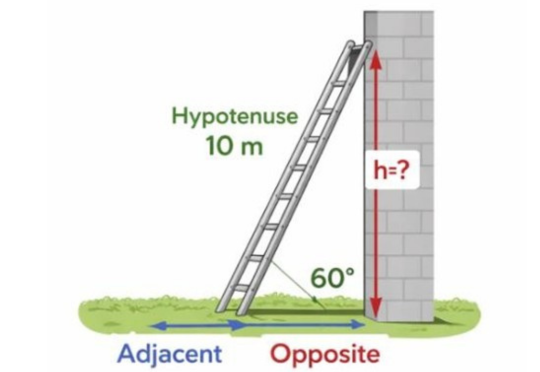
We have a right-angled triangle. The ladder is the hypotenuse (10 m). The angle with the ground is 60°. We need to find the height of the wall (opposite side).
Reference Angle: Our reference angle is 60◦.
Label Sides:
Hypotenuse = 10m (the ladder)
Opposite = h (the height we want to find)
Adjacent = (the distance from the wall to the base of the ladder – not needed here) Choose Ratio:
We have Opposite (h) and Hypotenuse (10m), and our angle is 60◦. The ratio connecting Opposite and Hypotenuse is Sine.
Set Up & Solve:
𝑠𝑖𝑛 (θ) = O𝑝𝑜𝑠𝑖𝑡𝑒/𝐻𝑦𝑝𝑜𝑡𝑒𝑛𝑢𝑠𝑒
𝑠𝑖𝑛 (60º) = h/10 𝑀𝑢𝑙𝑡𝑖𝑝𝑙𝑦 𝑏𝑜𝑡ℎ 𝑠𝑖𝑑𝑒𝑠 𝑏𝑦 10
h= 10 × 𝑠𝑖𝑛 (60º) 𝑈𝑠𝑖𝑛𝑔 𝑎 𝑐𝑎𝑙𝑐𝑢𝑙𝑎𝑡𝑜𝑟,
𝑠𝑖𝑛 (60º) ≈ 0.866
h= 10 x 0.866 = 8.66 𝑚𝑒𝑡𝑒𝑟𝑠
The ladder reaches approximately 8.66 meters up the wall.
Example 2: You are standing 25 feet away from the base of a tree. The angle of elevation to the top of the tree is 45 °. How tall is the tree?
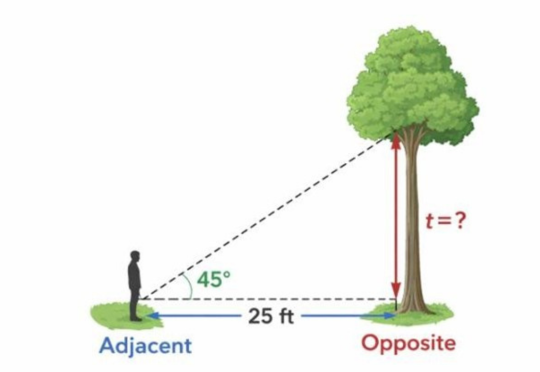
We have a right-angled triangle. Your distance from the tree is the Adjacent side (25ft). The angle of elevation is 45◦. We need to find the height of the tree.
Reference Angle: Our reference angle is 45 ° Label Sides:
Adjacent = 25ft (your distance from the tree)
Opposite = t (the tree’s height we want to find)
Hypotenuse = (your line of sight – not needed here) Choose Ratio:
We have Opposite (t) and Adjacent (25ft), and our angle is 45◦. The ratio connecting Opposite and Adjacent is Tangent.
Set Up & Solve:
𝑡𝑎𝑛(𝜽) = 𝑂𝑝𝑝𝑜𝑠𝑖𝑡𝑒/𝐴𝑑𝑗𝑎𝑐𝑒𝑛𝑡
𝑡𝑎𝑛 (45°) = 𝑡/25 𝑀𝑢𝑙𝑡𝑖𝑝𝑙𝑦 𝑏𝑜𝑡ℎ 𝑠𝑖𝑑𝑒𝑠 𝑏𝑦 25
𝑡 = 25 × 𝑡𝑎𝑛 (45 ◦) 𝑈𝑠𝑖𝑛𝑔 𝑎 𝑐𝑎𝑙𝑐𝑢𝑙𝑎𝑡𝑜𝑟,
𝑡𝑎𝑛 (45°) = 1 𝑡 = 25 × 1 = 25 𝑓𝑒𝑒𝑡
𝑇ℎ𝑒 𝑡𝑟𝑒𝑒 𝑖𝑠 25 𝑓𝑒𝑒𝑡 𝑡𝑎𝑙𝑙.
6. Common Mistakes to Avoid When Solving Trigonometry Problems
Mislabeling Sides
This is perhaps the most frequent error. Always remember that “opposite” and “adjacent” depend entirely on your chosen reference angle. The hypotenuse is always opposite the right angle, but the other two sides swap roles depending on which acute angle you are using. Take an extra moment to confirm your labels.
Choosing the Wrong Ratio
After correctly labelling your sides, ensure you pick the SOH, CAH, or TOA ratio that includes the information you have and the information you need. Forgetting which ratio uses which sides will lead you astray.
Calculator Mode
This is a silent killer! If your calculator is set to “radians” when the problem expects “degrees” (or vice-versa), all your answers will be incorrect. Always double-check your calculator’s mode, especially before an exam.
Algebraic Errors
Trigonometry often reduces to a simple algebraic equation. Basic errors in multiplication, division, or isolating the variable can ruin your answer, even if your trigonometric setup was perfect. Review your algebra skills! Not Drawing a Diagram
As mentioned, drawing a diagram is crucial. Trying to solve a problem purely in your head or by just reading the text can easily lead to confusion about which side is which. A visual aid clarifies the problem significantly.
In Addition
In today’s fast-paced world, online education unlocks endless possibilities for learners everywhere, offering flexible, personalized tutoring in subjects like math, science, and more, along with targeted test preparations for SAT, ACT, and beyond. Dive deeper into trigonometry mastery by exploring our related resources: check out our online tutoring platform, all designed to build your skills from anywhere, anytime.
