
Theoretical Foundation
What is trigonometry? Trigonometry is the study of relationships between angles and sides of triangles. It bridges geometry and algebra, helping us solve problems involving angles and distances.
The Right Triangle Most beginner trigonometry focuses on right triangles (triangles with one 90° angle). In a right triangle, we have:
- Two legs (the sides forming the right angle)
- One hypotenuse (the side opposite the right angle)
- Two acute angles (angles less than 90°)
The Three Basic Trigonometric Ratios To Solve Trigonometry Problems
For any acute angle in a right triangle, we define
Memory aid: SOHCAHTOA (Sine = Opposite/Hypotenuse, Cosine = Adjacent/Hypotenuse, Tangent = Opposite/Adjacent)
The “opposite” and “adjacent” sides are always defined relative to the angle you’re working with.
Step-by-Step Problem-Solving Method
Step 1: Draw and Label the Triangle
Start by sketching the right triangle and clearly marking
- The right angle (usually shown as a small square)
- The angle you’re working with
- All known measurements
- The side you need to find
Step 2: Identify What You Know and What You Need
Ask yourself, “Which sides or angles do I know? Which am I looking for?”
Step 3: Choose the Right Trigonometric Ratio
Determine which ratio (sin, cos, or tan) connects your known information to what you’re looking for.
Step 4: Set Up the Equation
Write the trigonometric equation using the ratio you selected.
Step 5: Solve the Equation
Use algebra to isolate and find your unknown value.
Step 6: Check Your Answer
Verify your answer makes sense (it should be reasonable for the triangle’s context).
Numerical Examples
Example 1: Finding a Missing Side
Problem: In a right triangle, one acute angle is 35°, and the hypotenuse is 10 meters. Find the length of the side opposite the 35° angle.
Solution:
Step 1 & 2: Setup
- Hypotenuse = 10 m (known)
- Angle = 35° (known)
- Opposite side = ? (unknown)
Step 3: Choose the ratio Since we know the hypotenuse and need the opposite side, we use: sin(35°) = Opposite / Hypotenuse
Step 4: Set up the equation sin(35°) = x / 10
Step 5: Solve x = 10 × sin(35°), x = 10 × 0.5736, x ≈ 5.74 meters
Step 6: Verification The opposite side (5.74 m) should be less than the hypotenuse (10 m). ✓
Example 2: Finding a Missing Angle
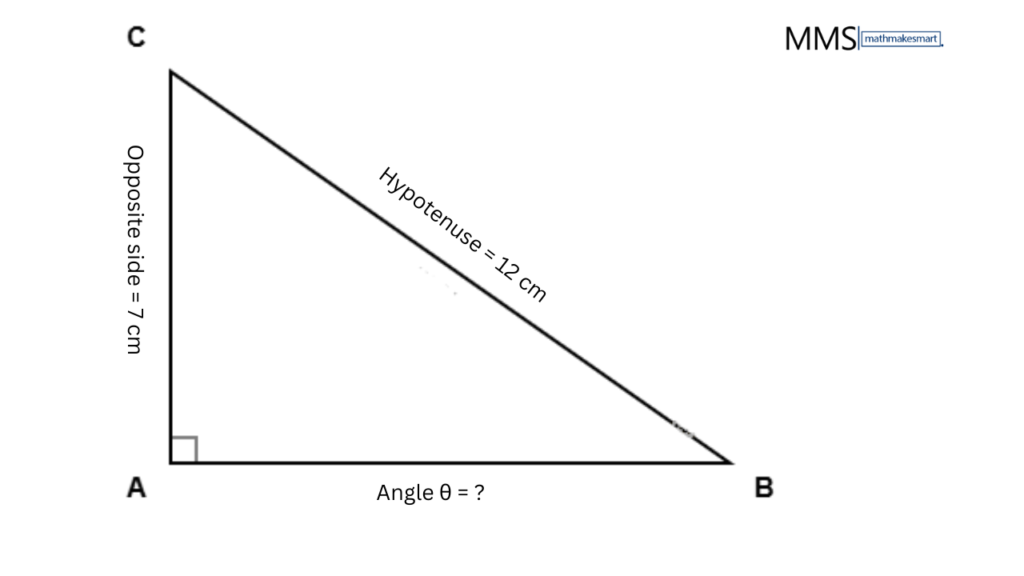
Problem: In a right triangle, the opposite side to angle θ is 7 cm, and the hypotenuse is 12 cm. Find angle θ.
Solution:
Step 1 & 2: Setup
- Opposite side = 7 cm (known)
- Hypotenuse = 12 cm (known)
- Angle θ = ? (unknown)
Step 3: Choose the ratio we use: sin(θ) = Opposite / Hypotenuse
Step 4: Set up the equation sin(θ) = 7 / 12 sin(θ) = 0.5833
Step 5: Solve θ = arcsin(0.5833) θ ≈ 35.69°
(Note: “arcsin” is the inverse of sine, written as “sin⁻¹.”)
Example 3: Using Tangent
Problem: A ladder leans against a wall. The ladder makes a 65° angle with the ground. The base of the ladder is 2.5 meters from the wall. How high does the ladder reach on the wall?

Solution:
Steps 1 & 2: Setup
- Angle with ground = 65°
- Adjacent side (base) = 2.5 m (known)
- Opposite side (height) = ? (unknown)
Step 3: Choose the ratio we use: tan(65°) = Opposite / Adjacent
Step 4: Set up the equation tan(65°) = x / 2.5
Step 5: Solve x = 2.5 × tan(65°), x = 2.5 × 2.1445 x ≈ 5.36 metres.
The ladder reaches approximately 5.36 meters high on the wall.
Common Tips for Beginners
- Always check your calculator settings Make sure your calculator is in “degree” mode when working with degree measurements (not “radian” mode).
- Know the inverse functions If you know a ratio and need the angle:
- sin⁻¹ or arcsin
- cos⁻¹ or arccos
- tan⁻¹ or arctan
- The Pythagorean Theorem is your friend If you find two sides using trigonometry, verify your work with a² + b² = c²
- Practice identifying opposite and adjacent These always depend on which angle you’re considering. Redraw the triangle from different angles to build intuition.
- Use real-world contexts Trigonometry models real situations: heights, distances, and angles of elevation/depression. Visualizing these helps understanding stick.
Note: If you are unable to detect errors in your solution, you must need help from an expert. For any kind of help in math, choose the best online math tutor in UK.
Practice Strategy
Start with problems where you find missing sides, then progress to finding missing angles. Once comfortable, tackle word problems that require setting up the triangle yourself. Consistent practice with varied problems builds both confidence and intuition for recognizing which tools to use. Always choose the best online tutor in UK if you want to solve trigonometry problems with ease.
If you’re looking for personalized help with maths, Math Make Smart offers online tutoring services in the UK and many other countries. Their team of experienced tutors makes learning maths easier and more fun. Whether you need help with homework or preparing for exams, they provide support tailored to your needs. Visit our website to find out how they can help you improve your math skills and build your confidence in the subject, whether you live in the UK or any other country like the USA, Canada, Ireland, New Zealand, and Australia.
