
Introduction to Trigonometric Identities
Trigonometric identities are the cornerstone of trigonometry, providing powerful equations that relate the various trigonometric functions and enable the simplification of complex expressions, solving of equations, and analysis of periodic phenomena in fields like physics, engineering, and computer graphics. These identities stem from geometric principles, such as the relationships in right-angled triangles and the unit circle, and they hold true for all angles where the functions are defined.
For students and learners, grasping these fundamentals not only aids in academic success but also builds a foundation for advanced topics like Fourier analysis or waveform modeling. In this guide, we’ll delve into the core principles of trigonometric identities, provide detailed explanations, and include practice problems with comprehensive solutions to reinforce your skills.
Fundamental Concepts of Trigonometric Identities
Trigonometric identities are equations that hold true for all values of the variables (within their domains) and are derived from the properties of triangles and the unit circle. They help in simplifying complex trig expressions and proving equivalences. Let’s break down the key categories with explanations, examples, and derivations where applicable.
1. Basic Trigonometric Functions
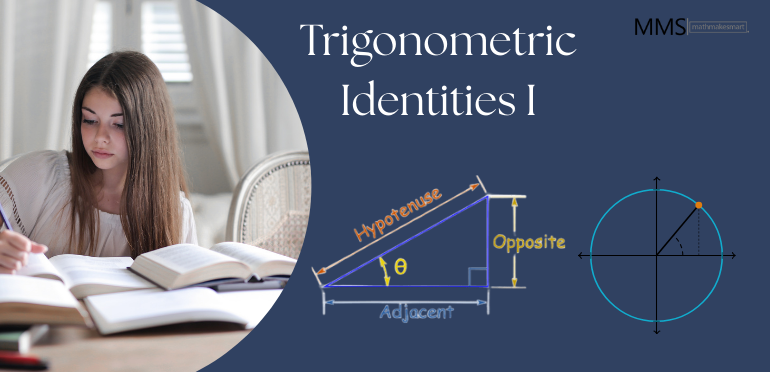
The six primary trigonometric functions are defined based on a right-angled triangle or the unit circle:
- Sine (sin θ) = opposite / hypotenuse
- Cosine (cos θ) = adjacent / hypotenuse
- Tangent (tan θ) = opposite / adjacent = sin θ / cos θ
- Cosecant (csc θ) = 1 / sin θ
- Secant (sec θ) = 1 / cos θ
- Cotangent (cot θ) = 1 / tan θ
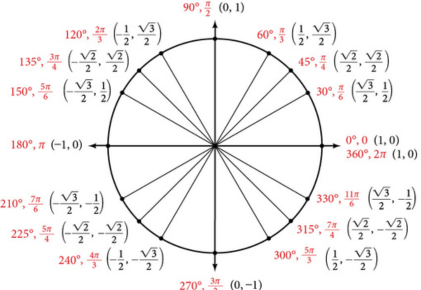
These are periodic functions, with periods like 2π for sin and cos and π for tan. On the unit circle, sin θ is the y-coordinate and cos θ is the x-coordinate, explaining their bounded ranges.
Example: For θ = 30°, sin 30° = 1/2, cos 30° = √3/2, and tan 30° = 1/√3.
2. Pythagorean Identities
Derived from the Pythagorean theorem on the unit circle (x² + y² = 1):
- sin²θ + cos²θ = 1
- 1 + tan²θ = sec²θ
- 1 + cot²θ = csc²θ
These allow substitution. Derivation: For unit circle, cos²θ + sin²θ = 1; divide by cos²θ for the tan-sec form.
Example: If cos θ = 4/5, sin θ = ±3/5 (sign by quadrant).
3. Reciprocal and Quotient Identities
- Reciprocal: csc θ = 1/sin θ, sec θ = 1/cos θ, cot θ = 1/tan θ
- Quotient: tan θ = sin θ / cos θ, cot θ = cos θ / sin θ
These are essential for rewriting. Example: Simplify sin θ / cos θ = tan θ.
4. Even-Odd Identities
- sin(-θ) = -sin θ (odd)
- cos(-θ) = cos θ (even)
- tan(-θ) = -tan θ (odd)
Derivation: From unit circle symmetry. Example: cos(-45°) = cos 45° = √2/2.
5. Sum and Difference Identities
- sin(A ± B) = sin A cos B ± cos A sin B
- cos(A ± B) = cos A cos B ∓ sin A sin B
- tan(A ± B) = (tan A ± tan B) / (1 ∓ tan A tan B)
Derivation: From angle addition formulas via rotation or law of sines/cosines. Example: sin(105°) = sin(60° + 45°) = (√3/2)(√2/2) + (1/2)(√2/2) = (√6 + √2)/ 4.
6. Double-Angle and Half-Angle Identities
- Double-Angle:
-
-
- sin(2θ) = 2 sin θ cos θ
- cos(2θ) = cos²θ – sin²θ = 2 cos²θ – 1 = 1 – 2 sin²θ
- tan(2θ) = 2 tan θ / (1 – tan²θ)
-
- Half-Angle:
-
- sin(θ/2) = ±√[(1 – cos θ)/2]
- cos(θ/2) = ±√[(1 + cos θ)/2]
- tan(θ/2) = sin θ / (1 + cos θ) = (1 – cos θ) / sin θ
Derivation: Double from sum with A=B; half from solving double-angle backward. Example: cos(230°) = 2(√3/2)² – 1 = 2*(3/4) – 1 = 3/2 – 1 = 1/2.
7. Product-to-Sum and Sum-to-Product Identities
- Product-to-Sum:
-
-
- sin A cos B = [sin(A+B) + sin(A-B)] / 2
- cos A sin B = [sin(A+B) – sin(A-B)] / 2
- cos A cos B = [cos(A+B) + cos(A-B)] / 2
- sin A sin B = [cos(A-B) – cos(A+B)] / 2
-
- Sum-to-Product:
-
- sin A + sin B = 2 sin[(A+B)/2] cos[(A-B)/2]
- sin A – sin B = 2 cos[(A+B)/2] sin[(A-B)/2]
- cos A + cos B = 2 cos[(A+B)/2] cos[(A-B)/2]
- cos A – cos B = -2 sin[(A+B)/2] sin[(A-B)/2]
Derivation: Add/subtract sum/difference identities. Example: cos 3θ cos θ = [cos(4θ) + cos(2θ)] / 2.
Practice Problems
To solidify your understanding, try these problems. Each includes the problem statement, a detailed solution guide with step-by-step reasoning, the final solution, common pitfalls, and pro tips for mastery.
Problem 1: Simplify the expression (sin²θ + cos²θ) / cos θ
- Solution Guide:
-
- Reasoning: This directly applies the primary Pythagorean identity to simplify the numerator.
- Step 1: Identify that sin²θ + cos²θ = 1 from the Pythagorean identity.
- Step 2: Substitute to get 1 / cos θ.
- Step 3: Recognize that 1 / cos θ is the definition of sec θ.
- Solution: sec θ
- Common Pitfall: Dividing each term separately instead of treating the numerator as a whole.
Pro Tips: Always scan for basic identities first; practice rewriting in terms of sin and cos if stuck. Use this in integrals where sec θ appears.
Problem 2: Prove that tan θ + cot θ = sec θ csc θ
- Solution Guide:
-
- Reasoning: Express both sides in terms of sin θ and cos θ to show equivalence.
- Step 1: Write tan θ = sin θ / cos θ and cot θ = cos θ / sin θ.
- Step 2: Add them: (sin θ / cos θ) + (cos θ / sin θ) = (sin²θ + cos²θ) / (sin θ cos θ).
- Step 3: Apply sin²θ + cos²θ = 1, simplifying to 1 / (sin θ cos θ).
- Step 4: For the right side, sec θ csc θ = (1 / cos θ) * (1 / sin θ) = 1 / (sin θ cos θ).
- Step 5: Both sides match, proving the identity.
- Solution: Identity proven (both sides equal 1 / (sin θ cos θ)).
- Common Pitfall: Forgetting the common denominator when adding fractions.
Pro Tips: Start from the more complex side; verify with specific values like θ = π/4 (both sides = 2). Apply in trig equation solving.
Problem 3: Find sin(75°) using sum identities (assume exact values)
- Solution Guide:
-
- Reasoning: Decompose 75° into 45° + 30°, angles with known exact values.
- Step 1: Use sin(A + B) = sin A cos B + cos A sin B, with A=45°, B=30°.
- Step 2: Plug in values: sin 45° = √2/2, cos 30° = √3/2, cos 45° = √2/2, sin 30° = 1/2.
- Step 3: Compute (√2/2)(√3/2) + (√2/2)(1/2) = √6/4 + √2/4.
- Step 4: Combine (√6 + √2)/4.
- Solution: (√6 + √2)/4
- Common Pitfall: Mixing up sum and difference formulas.
Pro Tips: Memorize key angles (0°, 30°, 45°, 60°, 90°); use for non-standard angles. Check with a calculator for verification.
Problem 4: Simplify cos(2θ) in terms of tan θ
- Solution Guide:
-
- Reasoning: Use the double-angle formula and divide by cos²θ to introduce tan θ.
- Step 1: Start with cos(2θ) = cos²θ – sin²θ.
- Step 2: Divide numerator and denominator by cos²θ (since the denominator is implicitly 1, but to normalize).
- Step 3: Numerator: (cos²θ – sin²θ)/cos²θ = 1 – tan²θ.
- Step 4: Denominator: 1 / cos²θ = sec²θ, but wait—actually, since the original denominator is 1, better: cos(2θ) = (cos²θ – sin²θ)/ 1. Divide num/den by cos²θ: num = 1 – tan²θ, den = sec²θ? No.
- Corrected: To make den 1 + tan²θ (which is sec²θ), yes, cos(2θ) = [ (cos²θ – sin²θ)/cos²θ ] / [ 1/cos²θ ], but a simpler realization: divide the entire expression by cos²θ + sin²θ = 1, but adjust.
- Standard: cos(2θ) = (1 – tan²θ) / (1 + tan²θ).
- Solution: (1 – tan²θ) / (1 + tan²θ)
- Common Pitfall: Incorrect algebraic manipulation during division.
Pro Tips: Useful when tan θ is given; derive other double angles similarly. Apply in tangent-based problems.
Problem 5: Solve for θ in [0, 2π) where sin(2θ) = 1/2
- Solution Guide:
-
- Reasoning: Solve for 2θ first, then halve; consider periodicity.
- Step 1: Sin φ = 1/2 where φ = 2θ; solutions φ = π/6 + 2kπ or φ = 5π/6 + 2kπ.
- Step 2: θ = (π/6 + 2kπ)/2 = π/12 + kπ; θ = (5π/6 + 2kπ)/2 = 5π/12 + kπ.
- Step 3: For k=0: π/12, 5π/12.
- Step 4: For k=1: π/12 + π = 13π/12, 5π/12 + π = 17π/12.
- Step 5: k=2 exceeds 2π; stop.
- Solution: θ = π/12, 5π/12, 13π/12, 17π/12
- Common Pitfall: Missing solutions from periodicity or quadrant signs.
Pro Tips: Graph the function for visualization; extend to other intervals. Use for wave equations.
Additional Problem 6: Simplify √[(1 – cos θ)/2]
- Solution Guide:
-
- Reasoning: Recognize as the half-angle formula for sine.
- Step 1: Recall sin(θ/2) = ±√[(1 – cos θ)/2].
- Step 2: The expression matches the absolute value form, assuming positive.
- Step 3: Consider the context for the sign.
- Solution: |sin(θ/2)|
- Common Pitfall: Ignoring the ± sign based on quadrant.
Pro Tips: Key in calculus substitutions; practice with θ=0 (0), θ=π (√2/2).
Additional Problem 7: Prove cos A cos B = [cos(A+B) + cos(A-B)] / 2
- Solution Guide:
-
- Reasoning: Use sum and difference to derive.
- Step 1: cos(A+B) = cos A cos B – sin A sin B.
- Step 2: cos(A-B) = cos A cos B + sin A sin B.
- Step 3: Add 2 cos A cos B.
- Step 4: Divide by 2.
- Solution: Proven.
- Common Pitfall: Confusing addition/subtraction.
Pro Tips: Memorize for Fourier transforms; derive sum-to-product similarly.
Practice these regularly to build intuition. For more, explore applications in real-world modelling.
Elevate Your Math Skills with Math Makes Smart Tutors
If you’re looking to deepen your grasp on trigonometric identities or any math topic, consider personalised guidance from Math Makes Smart’s expert tutors. Our private tutoring services offer one-on-one tutoring sessions tailored to your pace and needs, whether it’s homework help, exam prep, or conceptual mastery.
From algebra to advanced calculus, our tutors provide flexible online or in-person options to make maths accessible and enjoyable. Visit our website or contact us today for a free consultation—let Math Makes Smart help you achieve academic excellence!
